Monday, May 18, 2015

Blog post 9 semester 2 reflection

Final Reflection
Claudia Scully

This class has been a crazy series of ups and downs. From the start, I was surprised at how we kind of hit the ground running. In fact, especially at the beginning of the year, I felt this class was more difficult than the honors-level English courses I had taken in the previous three years. There were a lot more papers, and a lot longer of papers (seven pages, anyone?). They were also due a lot sooner, and there was just a lot of general confusion, especially with the technological aspects of the class. Blogs and OneDrive were especially frustrating, and I am not accustomed to referring to only the Edline calendar to find out my assignments. We did a lot of seminars, which I personally enjoy, and we read books that weren't horrible. When we did do projects, we got to choose our own topics, which was really cool. It was nice to finally have the opportunity to write about/research something I actually like and that I'm interested in.

I did quite well in the class overall. A lot of this comes from having the ability to choose topics or points of my own. And, as usually happens when you actually care about a subject, you want to do better, to go more in depth. That being said, I've gotten a low A in the first semester of the course, which I consider to be good. But, I actually feel like I've done better toward the end of the year. I believe my best project was the art and the artist PowerPoint. I've also become a lot stronger of a writer, especially in a formal setting, which has led to higher grades this semester.

Among many other things, this class taught me how to take my ideas, which tend to be very unclear, and shape them into an understandable thesis. I have become a lot better at presenting topics, because this is the first class I've taken that almost every time we have done a major project, it either is a presentation, or requires formally presenting the ideas to the entire class. I also learned how to keep a blog, and how to work OneDrive. This class has been very helpful in preparing me for college, especially in terms of how to plan and structure a long research paper, and how to budget my time in order to end up with a strong product. The iceberg view of culture and Maslow’s hierarchy have been strong anchors in terms of setting themes and ideas, and I hope to carry this to college as well.


Blog Post 8 semester two art and the artist ppt.

Blog post 7 Semester 2: Art and the Artist organizational chart

Blog Post 6, Semester 2

Prewriting for Art and the Artist project

Curiosita:
When I was a young child, I loved to sing. Whevever I was at my friend’s house, I wanted to play with her karaoke machine constantly. I didn’t ever stop making noise around the house. But Also, I liked to be the one to figure things out. In general, I was a problem-solver. I loved puzzles, solitaire, and sudoku, and I had no problem going through the directions for how to build a dresser from IKEA, connecting everyone’s phone to the car’s bluetooth, or setting up an itunes account. This quickly turned into becoming the technology troubleshooter of the house, which I’ve never minded. I’m still extremely interested in music-- I love to arrange music for choir. The arranging process actually integrates both of my childhood interest very well: Music and singing, but also, the process of arranging is like a puzzle to me. Where there are holes in the sound, or there is something missing, you have to create something to fill the spot and make the piece make sense not only to the singer, but to the listener.

Ted Talk:
I thought it was so interesting that she got a chance to see not just the art itself, but really how people responded to it. People will interpret what they see however they want, but often let their personal bias cloud the actual artist’s intention and purpose behind the piece. So it’s very interesting that she was able to show how different cultures depict themselves as opposed to how others might, and the assumptions that result from the observer.

Art form:

I want to talk about music in some way. I want to write a composition, which would be uncharted territory for me, as so far I've only tried arranging music (taking things that already exist and reinventing and reinterpreting them for a different style or feel.) This could be related to concept of self, as well as a comparison to others' styles. It is also very relevant to the concept of beauty--what one sees as beautiful, another sees as awful. Or, even what one culture of music may view as beautiful or good music, be it classical or contemporary, could be completely different. Here in america, we have Taylor Swift and Bruno Mars, but who are the equivalent of those people in India, Africa, Russia, or other parts of the world? Classical and traditional music also has great variation across the world. When it comes to op music, the definition of obscenity even comes into play, with certain words being even allowed in songs, where such vulgar themes aren't even considerable in other places, or wouldn't be valid even here a while ago. Whether or not include a composition of my own, I'd like to study this. However, it would be very cool to compare something I've written to music from composers now, the past, and even around the world.

Wednesday, May 6, 2015

Blog Post 5, Semester 2

This post includes my coverpage, final paper, and works cited, in that order.

Coverpage:


Final Paper:
 

Works Cited:


Blog Post 4, semester 2

This includes: Research Proposal, Research Questions & Annotated Bibliography

Research proposal/research questions:


Annotated Bibliography:


Thursday, March 26, 2015

Blog post 3 (semester 2) Research Paper Final Topic Selection & Final Graphic Organizers


*My specific research topic questions can be taken from the first version, posted above. I already created my own questions*

More Recent Research Proposal

I will be writing about the illusion of freedom in the Brave New World, and how their world leaders, or controllers, make that happen. By using psychological conditioning from a very young age, they’re taught that everyone belongs to everyone else, and that if they follow the rules of the world state, they will be happy. They either don’t seem to acknowledge their lack of freedom, or they simply don’t care that they don’t have any. I also want to cover why they don’t care, and why those few that do (Hemholtz, Bernard at the beginning of the book, for example), do what they’re told anyway. A source of mine from the American Psychological Association expresses “If a restriction is definite, people find a way to live with it….But if there is a chance [they] can beat it, than it makes sense… to motivate [them] to fight it” (Laurens). This also stems majorly off of the scene John made when flipping the soma tables, where he says “I’ll make you free, whether you want to or not” (213).
My end goal is to relate this back to how America is today, and to examine how free we actually are--Is our society really as great as we think it is, or do we just think that because it's what we've been told all along? While we obviously don’t condition people in their sleep, I want to see what we do as a country along a much less extreme line, for example, the kinds of information taught at a young age both in and out of school impacts their view of our American society, and how it relates to Brave New World.


Outline:


.

Friday, February 13, 2015

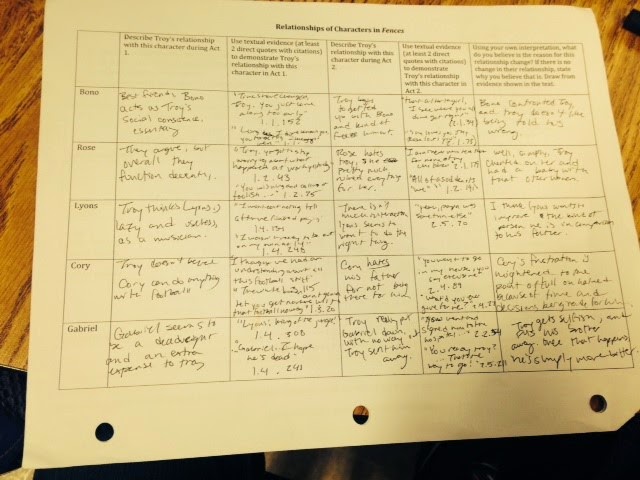
Blog Post 2 (semester 2)- Fences Socratic Seminar Items


Fences Socratic Seminar items

Part 1: 3x3 matrix

Troy is Closedminded
Decisions hurt family
Troy is dead

Part 2: Fences Questions

  • This description establishes Troy as an almost overwhelming character, somewhat arrogant, in a way. I Imagine a figure with his arms spread out, looking over everything as if they own it, looking down on everything. The imagery almost reminds me of how a ‘godlike statue’ or something of the sort would be described. This being said, I do think Troy believes he’s above other people, but I think he’s risen above. He still isn’t where he wants to be, therefore he still is striving to fill out his hands with accommodation.
  • Bono seems to act as Troy’s conscience for the most part. For example, Bono is the one to confront Troy about his affair with Alberta, saying “You been doing more than eyeing her” (1.1.45). He consistently reminds him of his responsibilities, saying, “She loves you, Troy. Rose loves you” (2.1.72). Bono is also the one Troy always seems to be trying to prove something to. Troy is telling Bono to listen to Lyons, to see and to recognize that, in Troy’s eyes, all Lyons wants is money. He does this in the same way one might try to rationalize with their conscience.
  • I think the climax of Fences is when Troy finally tells Rose about his affair with Alberta, and they had a massive argument. A lot of the action leading up to that point, particularly having to do with Bono, had dealt with handling the issue of Troy’s cheating, and after that argument, everything in the play that happened, especially in terms of Rose, dealt with how to take care of Raynell.
  • The blues as a musical genre is usually a style where one sings about their hardships, and that the struggle just keeps on going. I see blues in the overall themes of the play; not only that Lyons wants to be a Jazz musician—another style of music that has roots in the African American culture—but also in that there is constant misfortune after misfortune. Not only the music and themes, but also even the dialect coming from all of the speakers was somewhat representative of some of the slurring in blues music.
  • I think that Gabriel s kind of useless in terms of this play. I understand his function earlier on, but toward the end, his blowing on his ‘trumpet’ makes absolutely no sense, other than the obvious ‘Gabriel the angel blows a horn’ symbolism aspect. Overall I think that it’s out of place and serves no real purpose.
  • It’s no secret that there are a multitude of allusions throughout Fences. As far as Biblical Allusions go, Gabriel is the strongest example. Gabriel is the name of an angel, and at the end of the play, after he blows his horn, the heavens explode. Rose isn’t a biblical name, but a rose is a delicate, pure flower. Troy is Greek, as in the location of the Trojan war.

Part 3: Essential Questions
  1. What makes a house is a structure that people can live in. But a home is much more than that. ‘Home’ exceeds the structure, and refers much more to the sense of comfort and familiarity associated with the place where you live. A home has history, memories. It’s where someone grows up, makes their life. But most importantly, it’s where a person feels secure, both physically and emotionally. A home is somewhere you’re happy to be, and with people you love
  2. The success of one family member can either inspire the others to do better, or incite jealousy in them. In Fences, and example of both reactions can be seen in response to Cory’s wishes to be a football star. Rose is supportive, but Troy seems to be almost bitter about it. Failure has similar effects. It makes the family want to improve, or it makes them feel hopeless. Troy usually gives up whenever things aren’t a ‘success,’ but in a general sense, I don’t think that’s the best way to deal with failure.
  3. Traditions give a family a unique something special to just them. But overall, American tradition defines the family as the “nuclear family.” Breadwinner dad, homemaker mom, and their perfect however-many children. Of course, this is wildly unrealistic. When people grew up and realized that they weren’t living a “perfect” life, it made everything far less exciting. So, they added their own traditions—customs, even, and that’s what makes a family truly their own.

Part 4: Your Questions


  1. How do you connect the idea of freedom in this era and the repetition of the word “freedom” in MLK jr.’s Speech to the events in Fences?
    1. The repetition of the idea of freedom is almost like Troy’s internal constant of wanting to be happy, and wanting to be free of responsibility and hardship.
  2. If you were in Rose’s position, do you think you would’ve handled the situation the same way? What would you have done differently?
    1. In Rose’s position, I really don’t think I would’ve been able to handle the situation the way she did. She managed to set Troy in his place, but did not punish the child for it. I have a great deal of respect for Rose throughout the play.
  3. Do you think Troy made Cory’s decision for him because Lyons made his own decision and now he’s unemployed?
    1. Lyon’s failure may have had a little bit to do with Troy’s unwillingness to support Cory, but I think it really has a lot more to do with Troy’s failures in making a career in baseball.

Friday, January 9, 2015

Blog post 1 (semester 2)- socratic discussion plan

Family structure in the 1950s

Source 1- Washington post thing
  • Traditional Male-breadwinner-female-homemaker structure
  • 1950s 65% of all children 15 and under were being raised in this ‘traditional’ homes
    • today, only 22% are
  • Betty Friedan in the 1950s

Source 2- family in america website
  • all about “marriage and children”
  • CONFORMITY
  • Jacques Barzun’s comment of “An age of Troubles” is one that “fits every age in varying degrees”
  • Suburbs
  • Men working separated them from really ever being with their families
  • Those who got married and remained married are significantly more wealthy than those who never did or got divorced
  • “Marriage per se makes men more productive”

Source 3- global post source
  • “nuclear family”
  • 5.5% medical students were women, today its roughly half
  • women usually gave up their jobs when they got married
  • married at 22 and 20, now 26 and 25
  • 16% of families didn’t have indoor plumbing

Sunday, December 14, 2014

Blog Post #20 Their Eyes Were Watching God, Hamlet, and The Black Walnut Tree

3x3 Matrix
Janie lacks independence
Jodie hurts Janie
Janie kills Teacake

Poetry Comparison: The Black Walnut Tree
In both Their Eyes Were Watching God and "The Black Walnut Tree", there is a tree as a major theme. In both, this tree represents growing up. To Janie, this manifests itself in the form of a pear tree. A pear tree blossoms and bears fruit, which to Janie, represents becoming a woman. And while the girl's age in "The Black Walnut Tree" is not explicitly stated, I interpret her as being within her teenage years. The fact that she has to decide whether she wants to hold on to sentimental value or financial value encourages some experience of maturation, just like Janie. When Jodie dies, the book describes it as "The young girl was gone, but a handsome woman had taken her place" (Hurston.87), but this isn't the only time in the book when a statement along these lines is made. Whenever a significant period of her life ends-- including her realization that she is colored and therefore 'different,' and when she leaves Logan for Joe--  the same type of realization is described.

Hamlet Comparison:
Despite the many major difference between Shakespeare and Hurston's works--including medium, speech patterns, time period, and many more-- there are some parallels to be drawn between Hamlet and Their Eyes Were Watching God. The first is the role and significance of water. In both, water ultimately kills the main character's significant other. In Hamlet, Ophelia drowns herself, and in Their Eyes Were Watching God, Teacake's sickness doesn't allow him to safely drink water, and also drives him to madness after a massive flood. But, this isn't the only reason water is significant. Trees and gardens are also motifs through both, for the kingdom, and also for Janie in the pear tree. If these plants symbolize Hamlet and Janie, and plants need water to survive, then without Ophelia and Teacake, Hamlet and Janie began to wither, leading to their death; literal and metaphorical.

Tuesday, December 9, 2014

Sunday, November 23, 2014

Blog Post #17 Hamlet Post #5- Never Gonna Give You Up


             While this selection of song may seem odd, based on the lyrics, it relates quite well to King Claudius’ main goals in life. His most prized ‘possessions’ are, as he states, “my crown, mine own ambition, and my queen. (3.3.55)” This refers to his status as king, his overall ego, and Gertrude. He refers to her specifically as meaning a lot to him, saying “she is so conjunctive to my life and soul. (4.7.14)” And why would you, as per the song, ever want to give that up? He also says both “With mirth in funeral and dirge in marriage (1.2.12)” and “The queen, his mother, lives… for myself. (4.7.11-12)” Again, emphasizing Gertrude’s importance to him. At the end of the play, King Claudius also says to her, “Gertrude, do not drink! (5.2.254)” in reference to the cup he had poisoned in order to kill Hamlet. Of course, there’s still the matter of the king’s obsession with the throne. His words, “what’s in prater but this two-fold force? (3.3.48)” refers to both of the two, Gertrude and the kingdom. Although, he knows he’s done wrong—he knows the rules, and so does everyone else in Elsinore, like the song—so he knows that “The primal eldest curse—a brother’s murder, Pray, I cannot (3.3.37-39),” saying he cannot fully confess his sins to the people of the kingdom. For if he does, he will lose “the wicked prize itself, (3.3.59)” again, in reference to his status as king, his ego, and his wife.

                Going back to the original song choice, I do have to explain myself a bit. It seems ironic, given that the song has been given a reputation in more recent years as being a total joke. But, the writer originally intended for the song to be serious. “We've know each other for so long”—like Claudius and Gertrude. Of course, it cannot be overlooked that the word “her” is often used to refer to land, or certain objects, or even a country. Or, to be more accurate, just about any feminine pronouns, she her, etc., can be used for that purpose. So, if you said, Claudius never wants to five “her” up, it could easily be referring to Elsinore as well as Gertrude. So, essentially, the tone of the lyrics is serious, sincere, and genuine. The mood, though, is comedic almost, not really to be taken seriously, as the music is contradictory to the lyrics. It is very ironic, as is the choice of this particular song to be used at King Claudius’ funeral. But, this is cleared up when you think about how the king just thinks everything will work, explaining the cheerful music. However, though he doesn't ever give up, he does lose. Not only his wife and the kingdom, but also his life.

Thursday, November 13, 2014

Blog Post #15; Hamlet Post #3 To Be or Not To Be Soliloquy analysis

     The main metaphors are sleeping, which is a reference to death. this is proven when Hamlet says, "For in that sleep of death what dreams may come" (3.1.75). The other prominent metaphor in this soliloquy is the image of a dream, referring to heaven, or the afterlife. "To sleep, perchance, to dream..." (3.1.74). The whole passage is about how Hamlet doesn't know if he should go through with any of his plans, if they're worth it, if completing them will get him where he wants to be. This is reinforeced by camera angles being very close up in the film, as well as that he's talking to himself in a mirror, as a very literal inward reflection. Especially when he pulls out his knife and puints it at his mirror-self's throat: a symbol of his violence toward himself and in general. He also begins to question his own sanity, and has the validity of concience, "Thus concience does not make cowards of us all" (3.1.93).  But even more so, if He and his life are worth it. Considering "to be" is to exist, and to exist is to live, this soliloquy would be better titled "To Live or Not to Live." This offers a far better explanation for the frequency of his references to sleeping, and hopefully, dreaming, or dying, and hopefully going to somewhere better than his life is on earth.

     For the Ethan Hawke adaptation of the scene, the camera basically followed the Hamlet actor around a blockbuster movie-rental store. They only get about medium-far away, or medium-close, there isn't much angle variation. "Hamlet" was wearing darkeveryday clothes, black pants and a black hoodie-- which not only reflect his inner darkness of thoughts, but also may even suggest laziness, in terms of not dressing up. There was no outside noise, and every so often, the screen cut to show a tv with fire on it.  I believe that this was the best adaptation of the scene. After that, I would rank the version we've been watching in class as number  two, due to it's high attention to detail and how that translated into imagery and symbolism. Third, I'd rank the Mel Gibson version, I didn't feel as affected by the catacombs as a setting. While it really emphasized the looming grimness of the words, I thought it was too boring, too minimal. The last, and worst, adaptation, was the Lawrence Oliver scene. Not only did it not convey the message very well due to very little change in speech patterns and the feeling of someone just reading words as opposed to truly acting, the uncomfortable and even awkward positioning of the Hamlet character was highly distracting.

Monday, November 10, 2014

Blog Post #14; Hamlet Post #2


Hello internet, it's me again, King Claudius. So, I stumbled upon this movie last night when I was flipping throught the channels. I believe it was called Enchanted Ella, Ella Enchanted, something like that. There was this girl who did everything she was told, and she fell in love with this prince who had an uncle that took over the throne after his brother's death. Now, personally, I think there was too much focus on this weird obedient girl. The one who really intrigued me was the King. I couldn't stop thinking about how lucky he was that his blasted nephew didn't constantly get in the way of everything--Or at least not until many many years after he'd taken control of the throne. But the girl, oh, that girl, she gets in the way of literally everything. Such a troublemaker. They did not have to deal with the whole situation of 'uncle-father aunt-mother (2.2.325).' Aside from that, I was told that Fortinbras had given money 'so levied as before, against the Polack (2.2.74).' I feel like I should be slightly worried about his usage of my funds, but Polonius had much more important information to give me about Hamlet. After all, my well being is much greater than that of the kingdom's, right? He said to me, 'your noble son is mad: Mad I call it; for, to define true madness, whatt is't but to be nothing else but mad? (2.2.92-94)' Something had to be done about him. Or at least I needed to find some reason to take him down, send him out of the country maybe? England, perhaps? I don't know. All I can do now is hope he continues to dig himself into a hole 'of his own distemper (2.2.55).' I just keep hearing him talking about these players and some play, it seems to be his most recent source of raving. Just him in his room, repeating over and over again, "The play's the thing Wherein I'll catch the conscience of the king, (2.2.532-533)" whatever that is supposed to mean. One can only imagine, with Hamlet. Until next time.
#EllaEnchanted #NotJustAChickFlick #Personal

Friday, November 7, 2014

Blog Post #13; Hamlet Post #1 Hamlet Act I blog post

Okay, I was holding off on saying all of this, but now that I'm on the internet, the most safest place in the world where no one will ever find any of my deepest rantings, I guess it's safe to talk about it. Well, I've done it. I've finally done it. I, Claudius, am the king. The other day I married, she is a beautiful woman, that Gertrude, 'Our sometimes sister, now our queen (1.2.8).' Of course in marrying her I also now have Hamlet, 'my cousin, and my son (1.2.117).' Though, he doesn't seem to like me much. Here I am, trying to help him out and make him more manly by telling him that mourning his father is 'unmanly grief, a fault to nature and to heaven (1.2.101-102),' so that he can look better, and quite honestly so that he can make me look better. But no, of course that can't happen. Ugh. That's just one more reason I cannot wait until the mourning period of 'our late dear brother's death (1.2.19)' has ended. Then, maybe I'll be able to make some changes. Do what should  have been done ages ago. So long as Hamlet doesn't get in the way of all of it. Then people may ask questions, and I could risk my Throne. Obviously, that is not an option. Everyone just needs to move on so that we can make some progress.  #KingClaudius4evr #NothingsRottenInTheStateOfDenmark

Tuesday, November 4, 2014

Blog Post #12 Character choice: King Claudius

     I chose to look deeper into the behavior of King Claudius for a few reasons. The first and most obvious, my name is Claudia, his is Claudius, they're essentially the same. But also, there's a lot of complexity to his character. His actions are slightly fishy in general; marrying his deceased brother's wife/his "sister," becoming king when logically, the throne should've gone to Hamlet. He also creates a lot of conflict for Hamlet internally, because of Hamlet's rage toward him, which the king further fuels by challenging Hamlet's manhood and morality. He's social media relevant because if this were twitter, he'd have one of those little blue badges by his name--people would follow him just because of his title, making him influential and important in an online setting.

Tuesday, October 28, 2014

Blog post #10 Dream Children, A Reverie, Thesis Revision

Carefully read the passage from “Dream Child; a Reverie,” paying special attention to descriptive details and sentence structure. Then, write an essay in which you analyze how Charles Lamb’s style contributes to his portrayal of his “dream children,” his grandmother, and his own childhood.
_______________________________________________________________

Original Thesis:
Lamb's use of long phrases and large amounts of descriptiveness of his past and "dream" children portray how important both are to him by establishing a tone of reflection on old memories, and longing for a new generation to share in those memories.
_______________________________________________________________

ARGUMENT/FOCUS   

Yes  Does my thesis statement address each part of the essay question?
No    Is the point I'm making one that would generate discussion and argument, or is it one
that would leave people asking, “So what?"
Yes   Have I focused on an interesting contradiction, tension or paradox between two things?

Example: Although the escalation of violence in John Steinbeck’s Of Mice and Men eventually results in two deaths, it is through violence that compassion is revealed when George, in a violent but merciful act, saves Lenny from cruel mob justice.

A Bit  Is my thesis too vague? Too general? Should I focus on some more specific aspect of my
topic?
No    Does my thesis deal directly with the topic at hand, or is it a declaration of my personal
feelings (“I think”/ “I feel” statements)?

LANGUAGE

Yes  Does my thesis indicate the direction of my argument? Does it suggest a structure for
my paper?
Yes?  Is the language in my thesis vivid and clear? Have I structured my sentence so that the
important information is in the main clause? Have I used subordinate clauses to
house less important information? Have I used parallelism to show the relationship
between parts of my thesis? In short, is this thesis the very best sentence that it can be?
Yes   Is the thesis statement written as a complex sentence?ARGUMENT/FOCUS   

_______________________________________________________________

Revised Thesis

In "Dream Child; a Reverie," Charles Lamb's use of long phrases and flowery language--for example, his description of  "the old melancholy-looking yew tree,"--regarding his past and his goals for the future portray how important both are to him by establishing a tone of reflection on old memories, but also a somberness that comes out of his longing for a new generation with whom to share in these memories. 
_______________________________________________________________