This includes: Research Proposal, Research Questions & Annotated Bibliography
Research proposal/research questions:
Annotated Bibliography:
Wednesday, May 6, 2015

Thursday, March 26, 2015
Blog post 3 (semester 2) Research Paper Final Topic Selection & Final Graphic Organizers
*My specific research topic questions can be taken from the first version, posted above. I already created my own questions*
More Recent Research Proposal
I will be writing about the illusion of freedom in the Brave New World, and how their world leaders, or controllers, make that happen. By using psychological conditioning from a very young age, they’re taught that everyone belongs to everyone else, and that if they follow the rules of the world state, they will be happy. They either don’t seem to acknowledge their lack of freedom, or they simply don’t care that they don’t have any. I also want to cover why they don’t care, and why those few that do (Hemholtz, Bernard at the beginning of the book, for example), do what they’re told anyway. A source of mine from the American Psychological Association expresses “If a restriction is definite, people find a way to live with it….But if there is a chance [they] can beat it, than it makes sense… to motivate [them] to fight it” (Laurens). This also stems majorly off of the scene John made when flipping the soma tables, where he says “I’ll make you free, whether you want to or not” (213).
My end goal is to relate this back to how America is today, and to examine how free we actually are--Is our society really as great as we think it is, or do we just think that because it's what we've been told all along? While we obviously don’t condition people in their sleep, I want to see what we do as a country along a much less extreme line, for example, the kinds of information taught at a young age both in and out of school impacts their view of our American society, and how it relates to Brave New World.
Outline:
.
Friday, February 13, 2015
Blog Post 2 (semester 2)- Fences Socratic Seminar Items
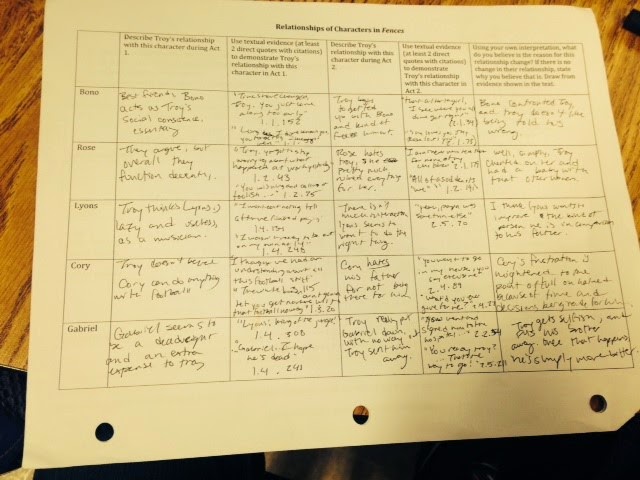
Fences Socratic Seminar items
Part 1: 3x3 matrix
Troy is Closedminded
Decisions hurt family
Troy is dead
Part 2: Fences Questions
- This description establishes Troy as an almost overwhelming character, somewhat arrogant, in a way. I Imagine a figure with his arms spread out, looking over everything as if they own it, looking down on everything. The imagery almost reminds me of how a ‘godlike statue’ or something of the sort would be described. This being said, I do think Troy believes he’s above other people, but I think he’s risen above. He still isn’t where he wants to be, therefore he still is striving to fill out his hands with accommodation.
- Bono seems to act as Troy’s conscience for the most part. For example, Bono is the one to confront Troy about his affair with Alberta, saying “You been doing more than eyeing her” (1.1.45). He consistently reminds him of his responsibilities, saying, “She loves you, Troy. Rose loves you” (2.1.72). Bono is also the one Troy always seems to be trying to prove something to. Troy is telling Bono to listen to Lyons, to see and to recognize that, in Troy’s eyes, all Lyons wants is money. He does this in the same way one might try to rationalize with their conscience.
- I think the climax of Fences is when Troy finally tells Rose about his affair with Alberta, and they had a massive argument. A lot of the action leading up to that point, particularly having to do with Bono, had dealt with handling the issue of Troy’s cheating, and after that argument, everything in the play that happened, especially in terms of Rose, dealt with how to take care of Raynell.
- The blues as a musical genre is usually a style where one sings about their hardships, and that the struggle just keeps on going. I see blues in the overall themes of the play; not only that Lyons wants to be a Jazz musician—another style of music that has roots in the African American culture—but also in that there is constant misfortune after misfortune. Not only the music and themes, but also even the dialect coming from all of the speakers was somewhat representative of some of the slurring in blues music.
- I think that Gabriel s kind of useless in terms of this play. I understand his function earlier on, but toward the end, his blowing on his ‘trumpet’ makes absolutely no sense, other than the obvious ‘Gabriel the angel blows a horn’ symbolism aspect. Overall I think that it’s out of place and serves no real purpose.
- It’s no secret that there are a multitude of allusions throughout Fences. As far as Biblical Allusions go, Gabriel is the strongest example. Gabriel is the name of an angel, and at the end of the play, after he blows his horn, the heavens explode. Rose isn’t a biblical name, but a rose is a delicate, pure flower. Troy is Greek, as in the location of the Trojan war.
Part 3: Essential Questions
- What makes a house is a structure that people can live in. But a home is much more than that. ‘Home’ exceeds the structure, and refers much more to the sense of comfort and familiarity associated with the place where you live. A home has history, memories. It’s where someone grows up, makes their life. But most importantly, it’s where a person feels secure, both physically and emotionally. A home is somewhere you’re happy to be, and with people you love
- The success of one family member can either inspire the others to do better, or incite jealousy in them. In Fences, and example of both reactions can be seen in response to Cory’s wishes to be a football star. Rose is supportive, but Troy seems to be almost bitter about it. Failure has similar effects. It makes the family want to improve, or it makes them feel hopeless. Troy usually gives up whenever things aren’t a ‘success,’ but in a general sense, I don’t think that’s the best way to deal with failure.
- Traditions give a family a unique something special to just them. But overall, American tradition defines the family as the “nuclear family.” Breadwinner dad, homemaker mom, and their perfect however-many children. Of course, this is wildly unrealistic. When people grew up and realized that they weren’t living a “perfect” life, it made everything far less exciting. So, they added their own traditions—customs, even, and that’s what makes a family truly their own.
Part 4: Your Questions
- How do you connect the idea of freedom in this era and the repetition of the word “freedom” in MLK jr.’s Speech to the events in Fences?
- The repetition of the idea of freedom is almost like Troy’s internal constant of wanting to be happy, and wanting to be free of responsibility and hardship.
- If you were in Rose’s position, do you think you would’ve handled the situation the same way? What would you have done differently?
- In Rose’s position, I really don’t think I would’ve been able to handle the situation the way she did. She managed to set Troy in his place, but did not punish the child for it. I have a great deal of respect for Rose throughout the play.
- Do you think Troy made Cory’s decision for him because Lyons made his own decision and now he’s unemployed?
- Lyon’s failure may have had a little bit to do with Troy’s unwillingness to support Cory, but I think it really has a lot more to do with Troy’s failures in making a career in baseball.
Friday, January 9, 2015
Blog post 1 (semester 2)- socratic discussion plan
Family structure in the 1950s
Source 1- Washington post thing
- Traditional Male-breadwinner-female-homemaker structure
- 1950s 65% of all children 15 and under were being raised in this ‘traditional’ homes
- today, only 22% are
- Betty Friedan in the 1950s
Source 2- family in america website
- all about “marriage and children”
- CONFORMITY
- Jacques Barzun’s comment of “An age of Troubles” is one that “fits every age in varying degrees”
- Suburbs
- Men working separated them from really ever being with their families
- Those who got married and remained married are significantly more wealthy than those who never did or got divorced
- “Marriage per se makes men more productive”
Source 3- global post source
- “nuclear family”
- 5.5% medical students were women, today its roughly half
- women usually gave up their jobs when they got married
- married at 22 and 20, now 26 and 25
- 16% of families didn’t have indoor plumbing
Sunday, December 14, 2014
Blog Post #20 Their Eyes Were Watching God, Hamlet, and The Black Walnut Tree
3x3 Matrix
Janie lacks independence
Jodie hurts Janie
Janie kills Teacake
Poetry Comparison: The Black Walnut Tree
In both Their Eyes Were Watching God and "The Black Walnut Tree", there is a tree as a major theme. In both, this tree represents growing up. To Janie, this manifests itself in the form of a pear tree. A pear tree blossoms and bears fruit, which to Janie, represents becoming a woman. And while the girl's age in "The Black Walnut Tree" is not explicitly stated, I interpret her as being within her teenage years. The fact that she has to decide whether she wants to hold on to sentimental value or financial value encourages some experience of maturation, just like Janie. When Jodie dies, the book describes it as "The young girl was gone, but a handsome woman had taken her place" (Hurston.87), but this isn't the only time in the book when a statement along these lines is made. Whenever a significant period of her life ends-- including her realization that she is colored and therefore 'different,' and when she leaves Logan for Joe-- the same type of realization is described.
Hamlet Comparison:
Despite the many major difference between Shakespeare and Hurston's works--including medium, speech patterns, time period, and many more-- there are some parallels to be drawn between Hamlet and Their Eyes Were Watching God. The first is the role and significance of water. In both, water ultimately kills the main character's significant other. In Hamlet, Ophelia drowns herself, and in Their Eyes Were Watching God, Teacake's sickness doesn't allow him to safely drink water, and also drives him to madness after a massive flood. But, this isn't the only reason water is significant. Trees and gardens are also motifs through both, for the kingdom, and also for Janie in the pear tree. If these plants symbolize Hamlet and Janie, and plants need water to survive, then without Ophelia and Teacake, Hamlet and Janie began to wither, leading to their death; literal and metaphorical.
Janie lacks independence
Jodie hurts Janie
Janie kills Teacake
Poetry Comparison: The Black Walnut Tree
In both Their Eyes Were Watching God and "The Black Walnut Tree", there is a tree as a major theme. In both, this tree represents growing up. To Janie, this manifests itself in the form of a pear tree. A pear tree blossoms and bears fruit, which to Janie, represents becoming a woman. And while the girl's age in "The Black Walnut Tree" is not explicitly stated, I interpret her as being within her teenage years. The fact that she has to decide whether she wants to hold on to sentimental value or financial value encourages some experience of maturation, just like Janie. When Jodie dies, the book describes it as "The young girl was gone, but a handsome woman had taken her place" (Hurston.87), but this isn't the only time in the book when a statement along these lines is made. Whenever a significant period of her life ends-- including her realization that she is colored and therefore 'different,' and when she leaves Logan for Joe-- the same type of realization is described.
Hamlet Comparison:
Despite the many major difference between Shakespeare and Hurston's works--including medium, speech patterns, time period, and many more-- there are some parallels to be drawn between Hamlet and Their Eyes Were Watching God. The first is the role and significance of water. In both, water ultimately kills the main character's significant other. In Hamlet, Ophelia drowns herself, and in Their Eyes Were Watching God, Teacake's sickness doesn't allow him to safely drink water, and also drives him to madness after a massive flood. But, this isn't the only reason water is significant. Trees and gardens are also motifs through both, for the kingdom, and also for Janie in the pear tree. If these plants symbolize Hamlet and Janie, and plants need water to survive, then without Ophelia and Teacake, Hamlet and Janie began to wither, leading to their death; literal and metaphorical.
Tuesday, December 9, 2014
Blog Post #19 Their Eyes Were Watching God Analysis Chart
I turned this chart in, I will be uploading pictures of the things momentarily.


Tuesday, December 2, 2014
Subscribe to:
Posts (Atom)